
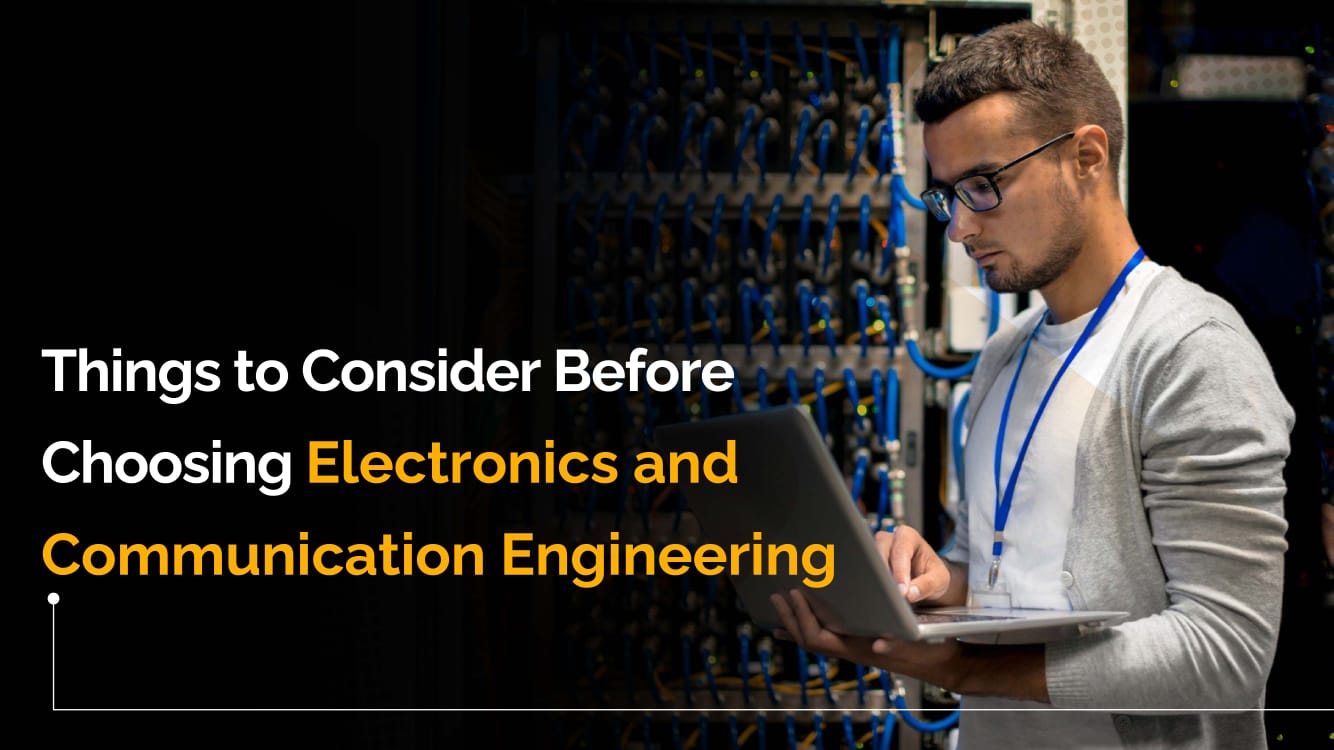
Willing to pursue an Electronics and Communication Engineering degree? Well, as a well-known discipline of engineering, ECE is concerned with the design, development, and upkeep of electronic equipment, communication systems, and associated technologies. Additionally, completing a degree from the electronics and communication engineering colleges can open up various job prospects for you,
But you should think about a few things that could affect your prospects and sense of fulfilment before deciding to enter the electronics and communication industry. In this article, we will look at some of those important factors.
Electronics and Communication Engineering- Course Information
The Electronics and Communications Engineering course specifically deals with the study, design, development, and testing of electronic tools utilised in multiple procedures. Moreover, the best engineering colleges in Jaipur offer a 4-year B.Tech degree in ECE, which focuses on producing electronic components, circuits, communications equipment, and so on. Some important highlights of a B.Tech (ECE) are tabulated below:
|
Full-Form |
Bachelor of Technology in Electronics and Communication Engineering |
|
Level of Education |
Undergraduate |
|
Course Duration |
4 years |
|
Minimum Requirement |
Complete 10+2 level of education in Science Stream |
|
Areas of Recruitment |
Telecommunications, Aerospace, Defense, Healthcare, etc. |
B.Tech in ECE- Eligibility Criteria
One of the leading B.Tech (ECE) colleges in Jaipur, Arya College, offers admission to candidates who meet the following requirements:
- Have completed their 10+2 level of education from a recognised Board of Education.
- Have studied Physics, Mathematics, and Chemistry/Computer Science/Biology/Biotechnology in the 12th Grade.
- Have secured a minimum aggregate of 45% in their 12th Standard. A 5% relaxation is given to the reserved category candidates.
Career Overview
With an average entry-level salary of INR 4.6 LPA, the graduates of the B Tech colleges in Jaipur can explore the following job profiles:
- Communication Engineer
- R&D Software Engineer
- Network Planning Engineer
- Desktop Support Engineer
- Electronic Design Engineer
Factors to Consider Before Choosing an Electronics and Communication Degree
You are aware that working in the field of ECE is both rewarding and quite diverse. But, learning about the study plan will better enable you to decide if it is the ideal career path for you. In light of this, we will go over certain fundamentals you must remember before enrolling in one of the electronics and communication engineering colleges in India:
- Interest and Passion
It is critical to evaluate your interest in and passion for a topic of study before deciding to pursue it. However, the discipline of electronics and communication engineering requires the application of complicated concepts, problem-solving, and ongoing learning. Therefore, if you have always been captivated by technology, have a knack for Mathematics and Physics, and have a keen interest in the inner workings of electrical gadgets and communication networks, pursuing ECE can be a great fit for you.
- Career Prospects
Before deciding on the ECE academic discipline, you must consider your employment alternatives. In general, the best electronics and communication engineering colleges in India train their graduates for a wide range of employment prospects in industries including telecommunications, information technology, consumer electronics, and more. Additionally, the future looks bright for ECE graduates as the demand for cutting-edge devices, effective communication systems, and technical developments increases.
- Academic Rigour
Strong backgrounds in mathematics, physics, and computer science are essential for the Electronics and Communication Engineering course. Additionally, this technical course is challenging and rigorous, including topics like electromagnetic theory, digital systems, signal processing, and circuit design. Therefore, you must evaluate your aptitude for these courses and your ability to bear the academic load before making a choice.
- Practical Skills
Electronics and communication engineering is a practical field that demands more than just academic understanding. Therefore, you should think about whether you enjoy creating electronic systems, building circuits, and debugging hardware and software issues. Additionally, professionals who graduate from private B Tech colleges in India frequently work in teams to build projects, necessitating strong interpersonal and teamwork skills. Hence, before picking up the course, ensure that you enjoy the process of translating theoretical ideas into practical applications by assessing your practical talents.
- Continuous Learning
Since technology is always advancing, ECE professionals must stay abreast of the most recent developments and trends. Additionally, if you want to work in the field of electronics and communication engineering, you must be dedicated to lifelong learning, keep up with new technologies, and constantly improve your skill set. Most essential, you need to figure out if you have the drive and desire for lifelong learning necessary to succeed in this industry.
- Personal Goals
Examine how your objectives and aspirations match with a career in ECE. And, think about your goal to progress technology, find solutions to pressing issues, or improve communication methods. In addition, consider whether earning ECE degrees from private colleges in India enables you to pursue a work-life balance that meets your tastes, as some career jobs in the industry may require long working hours or a lot of travel.
Summing Up
As long as you take into account the considerations described in this blog, deciding to attend the electronics and communication engineering colleges can be a fruitful choice. Most importantly, weigh your interests, career prospects, and personal goals to make an informed choice. Furthermore, a successful career in ECE also involves commitment, a strong work ethic, and persistence, so be sure your choice is based on serious thought.
FAQs
1. Is coding or programming important in ECE?
Yes, programming and coding are very important in ECE. Additionally, knowledge of programming languages like C, C++, Python, etc. is necessary for creating and putting electronic systems and algorithms into practice.
2. What emerging technologies are taught by the Electronics and Communication Engineering colleges?
Internet of Things (IoT), artificial intelligence (AI), 5G networks, embedded systems, robotics, virtual reality (VR), and nanotechnology are a few new technologies included in the curriculum of electronics and communication engineering colleges.
3. Is ECE a challenging engineering field?
Even though one of the most difficult engineering specialties is electronics and communication engineering, studying it will be easy if you are genuinely interested in the course topics.
4. Does Arya College Jaipur offer an M.Tech course in ECE?
Yes, Arya College in Jaipur offers an M.Tech in electronics and communication engineering. The college has a student intake capacity of 18 seats for this M.Tech course.
5. What skills are essential for ECE professionals?
Professionals in ECE should be adept at problem-solving, critical analysis, and analytical reasoning. Such professionals are also equipped with programming language knowledge, and great communication skills at electronics and communication engineering colleges.
